A Murder Book for Divorce

For more than 30 years, I have been addicted to murder mystery shows.  It all started with Benjamin Bratt on Law & Order.  He was so beautiful to watch, and even after he broke my heart and left the show, I was hooked.  

Before the days of streaming television and binge-watching, I watched Law & Order whenever it was on TV.  When my oldest child was in elementary school, she once commented that the now-infamous “dun, dun” sound at the beginning of each episode made her feel safe—she had heard it so much during her childhood.  (Kind of embarrassing for me, but adorable.)

I have expanded my obsession beyond Law & Order and Benjamin Bratt (who is still hot, FYI) and moved on to books and podcasts.  In each of these episodes or cases, the detectives always organize their information by creating a Murder Book.  Everything related to the crime goes in the murder book. 

When I heard the advice to create a Divorce Book, it made perfect sense to me. Everything related to the murder goes in one place, and everything related to the divorce goes into the Divorce Book.
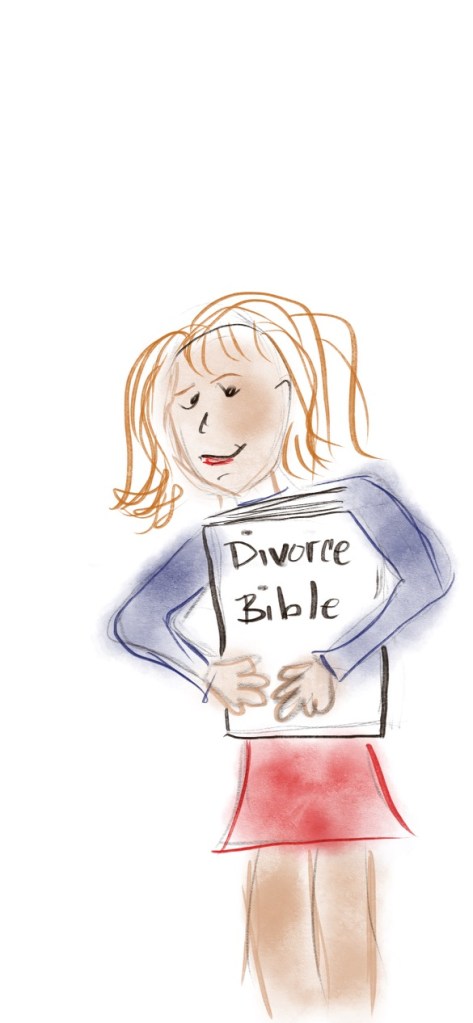
Illustration by Tricia Cummins Bell

Illustration: Tricia Cummins Bell

I don’t recall exactly where I first heard the term Divorce Book, but I am fairly sure it was on a podcast, most likely The Divorce and Beyond Podcast. Divorce brain, remember?  During divorce, it’s difficult to remember normal daily tasks, much less all the details you gather in preparation for divorce.

It’s imperative that you keep one central place to store that information. Divorce is a legal process that requires an astonishing amount of paperwork. Financial statements, bank and credit card records, insurance policies, retirement accounts, budgets, housing information, attorney and counselor contacts. The list grows quickly.

If you have children, there is even more to keep track of: school and extracurricular schedules, medical information, important contacts, and other records.

The type of Divorce Book you create is personal.  I am a teacher, and teachers—at least the older ones—love binders.  Mine eventually took the form of three binders, including two black ones that I kept mixing up.  It was often a mess, but I persisted. I kept organizing and reorganizing and never gave up. In the end, I gave my Divorce Book to my attorney.  

Start creating a Divorce Book now, even if it’s only a folder or a bunch of papers clipped together and shoved into a drawer, a box, or a paper bag.  Keep everything in one place until you can organize it better.

Many people prefer a digital format.  I eventually had both. My attorney required the paperwork to be delivered to her via email. But I needed to see and feel the paperwork in my hands. There was something about holding it that made everything real.  This wasn’t a test run. My divorce was actually happening.   

The form your Divorce Book takes is up to you.  Papers, binders, folders, boxes, computer files, or some combination of all of them. Just like life, divorce is messy.  It might take a while to figure out what works best for you.

It won’t be perfect, but it’s better than not trying. Start now. Keep everything related to your divorce in one place.  You can organize it later.

Bon courage.  You can do this.

Claire

We do not have to become heroes overnight. Just a step at a time, meeting each thing that comes up, seeing it is not as dreadful as it appeared, discovering we have the strength to stare it down.

Eleanor Roosevelt

N=1: We Are All a Study of One.

Have you ever tried the same diet as a friend only to watch the pounds melt off her while you gain weight?

Like many others, I have searched for the “right” way to lose weight—low fat, Keto, plant-based, carnivore, intermittent fasting. Yet the longer I read and experimented with nutrition, the more convinced I became that we are all a study of one.

It was a phrase I heard repeatedly in books and podcasts about health, and I realized it applied to much more than diet. What works for someone else, or even a group of people, might not work for you. The challenge is resisting the temptation to compare ourselves to others.

In a divorce, comparison can be especially damaging. I had heard about other divorces. Expensive court battles. Years of conflict. Financial devastation. Before I knew it, I began to measure my future against these divorce horror stories. How was I going to handle this crazy development in my life?

Then on a divorce podcast, I heard the phrase that changed my thinking: No two divorces are the same.

In my divorce, I realized that I would not have the same issues as others with more assets and younger children. While my divorced friends and I shared the common thread and pain of ending a marriage, the work would look different to me.

I learned that my divorce (and yours) would not mirror the divorces of friends, the rich and famous, or anyone else. We are all a study of one.

My divorce would be mine alone.

If no two people are the same and no two marriages are the same, why would we expect two divorces to be the same? Stop measuring your life against someone else’s. Don’t compare yourself to your married friends and family, and don’t compare yourself to your divorced friends and family.

In The Science of Stuck (2022), Britt Frank reminds us that comparison and perspective are not the same thing. Comparison keeps us stuck; perspective helps us move forward. It’s important to know the difference. Stop comparing and gain some perspective.

There will always be someone who is better off than you, and there will always be someone who is worse off. Perhaps that’s another way of saying what Teddy Roosevelt meant when he wrote, “Comparison is the thief of joy.”  

Just like in our dieting and health journeys, in divorce, we are all a study of one.

N = 1.

Bon Courage. You can do this.

Claire

We do not have to become heroes overnight. Just a step at a time, meeting each thing that comes up, seeing it is not as dreadful as it appeared, discovering we have the strength to stare it down.

Eleanor Roosevelt

You Can’t Learn Divorce from a Book

I know that’s a strange statement coming from someone who wrote one, so let me explain.

My sister once tried to describe Excel pivot tables to me.   She was so excited about what they could do.  It wasn’t until I built one myself that I finally understood them. 

Divorce can be like that, only the stakes and emotions are much higher. Books, articles, and other people’s stories can help you prepare for a divorce but reading and hearing about experiences are not the same as living them. 

People told me that it wouldn’t be over quickly.  They were right.

People told me to get my finances in order.   They were right.

People told me divorce would be painful.  They were right. 

I read and heard all these warnings and researched the process, but one step at a time was the only way to get through it. As much as I wanted to close my eyes and wake up on the other side, there was no shortcut. I had to walk through every emotion, every setback, and eventually, every victory myself. 

Hit by a Truck can help soften the learning curve with tips, examples, and stories, but it cannot live it for you.  In the end, it’s the living that teaches us. 

Bon Courage.  You can do this.

Claire

We do not have to become heroes overnight. Just a step at a time, meeting each thing that comes up, seeing it is not as dreadful as it appeared, discovering we have the strength to stare it down.

Eleanor Roosevelt

Divorce Brain. It’s a real thing.

Illustration by Tricia Cummins Bell

Divorce Brain. It’s a real thing—and it sucks.

During my divorce, I found myself reading the same information over and over before I could fully understand or remember it. I took notes, printed articles, and highlighted important passages because I was afraid I would forget what I had just learned.

Many times, I forgot to save the source of an article or podcast episode. Later, I would spend hours searching for something I knew I had read or heard, only to come up empty-handed.

I learned that it was best to save important information the moment I found it. The mental fog that often accompanies divorce can make it difficult to absorb, process, and retain information the first time around.

The internet is vast, and once information is lost, it can be difficult to find again—especially when you’re dealing with a brain on divorce.

I have heard this phenomenon referred to as “divorce brain.”

It’s a real thing—and it sucks.

Divorce brain can make you feel slow, forgetful, distracted, and sometimes even a little crazy. You may wonder why simple decisions suddenly feel overwhelming or why it takes so much effort to concentrate.

You are neither stupid nor crazy.

You are experiencing trauma. Divorce is traumatic, but it’s not terminal.

The fog will lift. Your ability to focus, remember, and make decisions will return. It may happen gradually rather than all at once, but it will happen.

Until then, give yourself some grace.

Take notes. Save articles. Write things down. Allow yourself extra time to make decisions. Accept that you may make mistakes along the way. I certainly did.

When—not if—that happens, pick yourself up, dust off the frustration, and keep moving forward.

Bon Courage. You can do this.

Claire

We do not have to become heroes overnight. Just a step at a time, meeting each thing that comes up, seeing it is not as dreadful as it appeared, discovering we have the strength to stare it down.

Eleanor Roosevelt